Archives

Core-Po-rate Fitness (Staying Fit in the Office)

You might be thinking… why is the title written in such a manner? Well, this article is being published because of a single man who I consider to be a brother. I am sure in time you will find out more about some of my closest friends but “Po” and “Pablo” (these names are used to protect identities) are almost definitely my oldest closest friends. I have known them for the longest time of the few friends I stay in touch with on the regular. Therefore, the core comes from what you will be doing, the Po is for his name and it somewhat misspells but spells out the word corporate.

"Po" with a delicious donut

“Po” with a delicious donut

So Po texted me this morning and said that I “should do a post on a sweat-free guide to corporate fitness” because he seems to “feel all fat and bloated sitting at my office desk.” As he pointed out, “sweating is crucial to a healthy workout… but not conducive to business attire.” Well, Po is obviously very accurate in what he is saying. I know that everyone watches Bond movies and says how does Sean Connery/Roger Moore/Timothy Dalton/George Lazenby/Pierce Brosnan/Daniel Craig manage to be in such good shape and chase criminals at full speed for miles while wearing a very tight tuxedo or suit? We all know that it’s a movie and it’s very challenging to workout in that business attire for a few reasons.

Up and coming James Bond

Up and coming James Bond

First, you don’t want to ruin expensive clothes. Second, you lose a whole lot of range of motion when wearing button down shirts or skirts. Third, when you have those tight-fitting clothes on, your body temperature raises faster… causing you to SWEAT MORE. So we have to figure out how to increase someone’s physical fitness in the corporate world without sweating? Well, let’s talk about sweat, baby.

If dogs could sweat, SHE WOULD!

If dogs could sweat, SHE WOULD!

Sweat, more properly known as perspiration, is the release of fluids in mammals from two different glands that are more or less distributed over the skin of your whole body. Sweating is the body’s way of regulating its temperature in hot weather. In tropical climates near the Equator, especially in Southeast Asia, spicy foods are staples in diets because they help stimulate a sweat response which leads to water on one’s skins evaporating causing a cooling effect. Depending on the individual and many factors, the secretion of fluids can range from not so much to a ton. I have never perspired a lot, however a high school friend who captained the football and wrestling teams perspired just by sitting still. That is why we should not compare ourselves to one another and deal with your body when figuring out what you need to do. Males can perspire anywhere from 2-4 liters in an hour… which is a large range. Finally, men start perspiring much quicker than females, even though both genders have the same perspiration when they are exercising at the same intensity.

Beautiful picture of Alana sweating after a Spartacus workout

Beautiful picture of Alana sweating after a Spartacus workout

Now that we know the basics about sweating, how can we avoid it? Obviously, we sweat more when we exert more force on our muscles because they heat up and this doesn’t help our problem. We need to figure out a way to not sweat but still exert force on our muscles. It seems impossible. The issue here isn’t being able to find a way to exercise intensely while wearing business attire. It is how can we change our overall lifestyle, while coping with our occupation, in order to feel good all the time. That can be challenging when sitting down at a desk for eight or nine hours, even with a lunch break in the middle. I know how that feels when I am tied to my desk on Fridays, some nights and some weekends. So let’s outfit a day that can make us feel better because not everyone can afford a treadmill desk or is allowed to use a stability ball instead of an office chair.

Aside: That’s right everyone… there is something called a treadmill desk and you can research it more to find out about it. Otherwise, if you are working at a place where they don’t mind swapping office chairs for a stability ball, then please make that purchase and switch. Sitting on a stability ball forces you to utilize your core muscles while sitting and typically that results in better posture and a workout that lasts all day long. You can also bounce up and down and get a leg workout when people aren’t watching you! Do that in moderation and you won’t even break a sweat.

This is going to come back to the three basics of a healthy lifestyle: Exercise, nutrition, and rest. Make sure you are getting an ample amount of sleep every night before you have to wake up to go to work. I say 6-8 hours, which makes 7 seem like the magic number. Some professional athletes sleep 10-12 hours but there are studies that show that can actually have negative effects.

Make sure you are eating healthy meals throughout the day. If you are trying to stay lean, it helps to keep your metabolism fired up by spacing out 6-8 small meals that meet your macronutrient goals. If you don’t want to measure macros, then just don’t eat garbage. Eat well! Ask away if you want recommendations for office snacks that can help fight cravings for junk food and help keep your metabolism fired up.

Salad

Salad

Finally, try to get some physical activity in every day. You don’t need to hit the gym if it doesn’t fit your schedule. Fifteen minutes are all you need. I recommend working out when you wake up if you have a corporate job because then you can be happy with what you did and not have to think about what you’re going to work out for the rest of the day. Mike Chang just did a YouTube video on the same topic so check it out. But here is what I recommend for physical activity in the office to keep you loose. These are exercises that will not make you sweat but will help keep your metabolism up, joints healthy, and muscles loose.

This can make the difference! Photo from FitSugar

Flexing – I’m not joking. When you flex your muscles, you are contracting them and then releasing the contraction. It’s the same thing you do with a weight but there is less resistance. When I drive for more than 3 straight hours I will typically sit straight up with my back off the chair and start contracting my abs. All of them one at a time (upper, lower, obliques) in a circuit. You can do it without thinking.

Flex!

Flex!

Bring a resistance band to work. Tie it up under your chair and do some side deltoid (shoulder) raises or front deltoid raises. You can do some curls also. If you want to wrap it around your ankles then you can do some leg extensions. Just by using proper posture and some very light weight exercises you can FEEL better. That is what this is all about.

Po is an athletic guy that is in good shape but sitting around makes him and all of us feel LAZY and bad about ourselves. Just by doing these exercises, with a range of motion that fits your attire, you can feel so much better about yourself while you are sitting down because you are trying. And a lot of these don’t take much time or effort but they can keep you loose, strengthen your joints, help stretch, and keep your metabolic rate up throughout the day. If you want recommendations about resistance tubes and bands, just ask away in the comment section below. Some are better suited for certain people. Plus, they are very easy to transport unlike heavy weights. And like I said, you can do those exercises without even thinking. Low risk of injury when using that type of resistance.

I will try to make a video of me dressed in business attire sitting at a desk doing these exercises so you get the idea but remember that this is about feeling better so do what you need to do to stay happy, hungry and fit! (REMEMBER that we are here for YOU and are willing to do posts on just about anything that you want to know more about. We will answer all requests and questions to the best of our ability no matter what the topic is related to. Just put what you want us to write about in the comment section below or email it to hungryandfit@gmail.com)

You might also like…

BONUS KITTY PIC

Nymeria being cute

Nymeria being cute

spacer

Building Muscle & Losing Fat (Myths of Fitness)

Myths of Fitness might not be the greatest name for this series but it’s all we have for now. The whole reason that I made up such a boring and vague name comes from my immediate desire to spread this information. Now, I am sure that we have said this before, but it IS possible to lose fat and build muscle at the same time. Here I will explain it shortly without getting into detail about the scientific and specific aspects that are better explained through some links below. This is a better explanation for people who want to know the truth and those links provide the better explanations for those who want to know the reasons that make it true.

Hittin da gym in Iowa

Hittin da gym in Iowa

First and most importantly, you as an individual need to figure out what your goal is! The reason why I have a general problem with P90X, Insanity, Total Immersion Swimming, and other similar programs that are products you need to pay for is because they act like these programs are the solution to everyone’s needs. This obviously is not the case since all individuals interested in getting in better shape are different anatomically, physiologically, psychologically, etc. Basically, everyone is physically and mentally different from everyone else. So you need a program that caters specifically to your needs. While I have many problems with those products the one reason why I do like their popularity is that they are helping get people off of the couch. (Just be careful that once you get off the couch you don’t get hurt because it’s in the nature of some of those programs to accidentally let that happen.) But my rants about those products, triathlons, obstacle races, and Crossfit will come at another time. (It will be a “the good, the bad, and the ugly.”)

Going back to how I started the last paragraph… what is your goal? If you want to be massive then your goal is hypertrophy and mass gain. If you want to be super lean then you’re on the other side of the spectrum. If you want to maintain your appearance, it’s another different story. Professional bodybuilders, pro athletes, endurance athletes, martial artists, dancers, professional eaters, and everyone else on this planet should take different approaches to reaching their goals and this is where we come back to that myth of not being able to build muscle and lose fat at the same time.

photo 2 (17)

If you focus on one goal (I struggle with this) then it is typically easier to achieve. Or at least you can achieve it quicker. Bodybuilders go through a bulking cycle where they pack on extra mass and fat in order to help their muscles go through hypertrophy. Once they have achieved their desired size in terms of specific muscle groups, they continue to exercise rigorously while cutting. While they are in a cutting cycle, they will lower their body fat and mass significantly while maintaining a significant amount of their hypertrophic progress in their muscles. That is the end result of what you see when you watch the Olympia or the Arnold Classic. I won’t go into significant detail about their diet and supplementation other than the fact that they try to eat more calories while bulking and a caloric deficit while cutting. This is the optimal way to maximize gains in a mere aesthetic manner.

However, if you are more interested in building “functional” muscles (don’t take me using functional literally. Every workout leads to the growth of functional muscle. Some would argue that some forms are more “functional” or useful than others) then you should consider find what program suits you best. Everyone can be classified as a mesomorph, ectomorph, or endomorph. (See our old glossary of fitness terms for an explanation.) In order to find the perfect mix of macronutrients and exercise in order to build muscle and lose fat you need to go through something called… trial and error. I cannot be convinced that there is a single “adonis ratio” that calculates every person’s needs equally. We are all far too different. You can hire “coaches” to help you and guide you but be careful and make sure they have your best interests in mind. You might hear of a coach telling a client to eat under 20 grams of fat a day. Please do not listen to them. You need fat to control hormone production and for hundreds of other functions. But that is another post we’ll talk about at another time.

photo 1 (20)

Bottom Line: You can build more muscle if you are just trying to build muscle. You need the excess calories and other factors to help you gain mass. You can cut more fat is you are just trying to cut fat. You need the caloric deficit and other factors to help lose fat. However, if you are interested in doing both at the same time… you can. Obviously it isn’t possible to maintain a caloric surplus and deficit at the same time but for beginners, overweight individuals, and exceptional people it is more likely to be able to build muscle and lose fat at the same time. Also, depending on your macronutrients, you can “build muscle” (in various ways, not mass necessarily) while on a slight caloric deficit or a caloric balance. You won’t build quite as much muscle or lose quite as much fat, but you can still be efficient and help reach YOUR goals. Don’t listen to anyone else since you have YOUR goals and it is YOUR body. My goal right now… be happy in life. If I want ice cream then I’m having ice cream. And you should do the same because happiness is a key factor in staying hungry and fit.

Gettin' some Frisbee Golf on

Gettin’ some Frisbee Golf on

Here are two great links to two great individuals that I look up to in the scientific side of the fitness industry. Jim Stoppani provides individuals with hundreds of phenomenal workout programs… many for free. Congratulations to Dr. Layne Norton in the birth of his son. Best of luck to your family.

http://www.cutandjacked.com/CutAndJacked-Ask-Dr-Layne-Norton

http://www.jimstoppani.com/home/questions/187

You might also like…

spacer

Some Help on Training Splits and Achieving Goals

This is going to be a fairly short post compared to what I can say on the topic but it was prompted by my own changing of my split. Obviously, there are many muscle groups in your body. Major muscle groups include pull muscles, push muscles, lower body, core, and so on. Some people like to split them up even further into back, biceps, triceps, chest, abs, quads, calves, and even more. Some people like to split them up even more but I won’t do that to you.

photo (16)

Depending on your fitness goals, you might be trying to focus on certain muscle groups more than others. If you’re trying to lose weight, you’re probably targeting all those groups equally in some intense interval training paired with lots of cardio to cut down. If you’re trying to gain mass and strength you might be methodically working out each group in detail in order to build clear-cut muscles so your arms don’t fit in your shirt. Either way, it is very intelligent to plan your approach to achieving your goals.

Every personal trainer initially assesses their client’s health conditions, background in fitness, personal goals, nutritional plan and diet and so forth. This information helps the trainer create the most fitting workouts and lifestyle for their client to achieve these goals. Even personal trainers and professional bodybuilders have trainers and nutritionists that help them achieve their goals so don’t think that you’re too good or smart for some help. It’s always helpful to have someone objective pushing you and leading the way, constantly motivating you to achieve your own goals. It’s hard for me to push myself to failure when I don’t have that motivation or person telling me try harder. Whatever your motivation might be, some extra push can help if the person with you knows what they are doing.

photo (17)

Splits have many depending factors, such as time. How often do you plan to do strength workouts? Every day? Every other? Maybe every 3 days. Depending on which one, you want to plan your workouts accordingly to give enough rest and recovery time. What happens when we don’t give ourselves proper recovery time? We overtrain and lose progress. So plan to give yourself proper rest in between each muscle group to avoid overtraining.

You typically wouldn’t want to go to the gym and work your chest out every day. This would not allow proper time to recover. Depending on your personal recovery rate, you may be ready to workout a certain group every other day, although that is rare. I typically allow somewhere around 4 days before repeating a workout that is targeting the same muscle group if they are intense workouts. If you plan on doing full body workouts multiple times a week and are not trying to gain massive amounts of strength, power, or size, less rest is necessary.

photo (19)

Some of the greatest bodybuilders of all time have claimed to workout only two to three times a week while some workout six days a week doing double sessions every day. No matter what you decide, to do make sure you are allowing proper recovery time. If you have any questions about how to fit “cardio”, strength training, performance training or whatever you do together to maximize results, please let us know in the comment section below. With these tips, we hope you can stay even more hungry and fit!

photo (18)

You may also like:

spacer

5 Ways to Firm Up Your Glutes

No matter what gender we are, we all want to have nice glutes. And besides aesthetics, the stronger our glutes are, the more powerful we are. Think of when you feel your glutes: walking up the stairs, the beginning part of sprinting, and standing up from kneeling or squatting. Improve your gluteal muscles and you will get up the stairs faster, be able to run and sprint faster, and spring up from the ground like a ten-year old. These are 5 simple exercises that can be performed anywhere!

1. Doggies. You’ve heard me talk about these before, and I will again because it’s such a great exercise for the glutes! And the more you do without stopping, the better workout it is for those muscles. Go on your hands and knees, kick your leg back and then rotate it around to starting position, keeping the leg in line with your hips. Keep going until you can’t and then go right away to the other side.

2. Hip bridges. This can be done with or without a stability ball. Lie on your back with your feet on the floor, knees bent. Now, lift up, bringing your hips and glutes up. If you want a deeper exercise, you can go up on your toes to get higher. Come down, but don’t touch the floor. Continue up and down, squeezing the glutes at the top until failure. If you want to use a stability ball, simply put your calves on top of it and do the same motion.

3. Box jumps. For this, you can use an athletic box, stepper, a chair, a couch–anything that is raised and stable. Focusing on using your glutes, spring up with both feet and jump onto the top of the box. Try to synchronize so both feet hit at the same time. This is also a cardio workout if you do it repeatedly. Slightly squat down so you can get power, and jump up!

4. Step ups with leg extension. This is different from regular step-ups. Have something similar to what you had for box jumps–a box, a stepper, a chair, a couch, whatever you can find. Now step up with one leg, and extend the other as high as you can behind you which clenches the glutes. Now do the same on the other side. Do this until your glutes and hips cramp up so you can’t do another (aka until failure!).

5. Bobbing squat. You will really feel the burn with this one. Get into a squatting position and hold. Now bob your hips and glutes up and down in little motions. Go for as long as you can until the burn is just too much. Don’t forget to time yourself and try to beat your own record!

So if you’re looking to have buns of steel for the summer time, or better, for your lifetime, make these few exercises a part of your routine. They’re easy to remember and simple to do (though they burn if you do it right!), giving you no excuses not to have the glutes of your dreams! Click here if you’re looking for an over-all non-machine leg workout! Use these exercises to stay…hungry and fit! 

BONUS KITTY PIC

Nymeria found a nice little spot

Nymeria found a nice little spot

spacer

Running with Thunder

First of all, that sounds like an awesome Native American name. Second of all, let me start off with saying that, I am not a runner. I am not good at running, but I am learning to be better. Most people think, since I’m a personal trainer, that I am good at and/or enjoy every form of exercise. Wrong. But right now, we are gearing up to do an obstacle race (i.e. Warrior Dash) training class so I need to get my endurance up. Okay, back to why I’m writing this.

I’ve been running two miles lately, never going past it. I’ve been able to manage it semi-alright lately. And I’ve been trying to do it at a park, McIntosh Park, close to work. With the mindset of doing another 2 miles yesterday, with the possibility of going a little further, the clouds rolled in. I didn’t really think it was going to rain, but as I hit the pavement/trail, drops began to fall. Thunderheads were in the distance and, soon enough, they began rumbling. Rain starting falling heavier and lightning flashed–actually saw the bolts!

photo 1 (7)

McIntosh Lake

McIntosh Lake

By the two mile run, I still had enough energy. I had my headphones in, but no music playing (didn’t feel like holding them) so I could hear the rain and thunder. Somehow, I think it energized me because I was enjoying it. Though my feet were getting tired, I plugged on. I was slightly wary of getting struck by lightning during the no-trees part, but I figured that would make a good story, too.

photo 3 (3)

I ended up running the full trail–3.6 miles! I was absolutely shocked and extremely proud of myself for going the whole way without stopping–at a decent pace too! Took me 32 minutes for the thing. After an experience like that, I can appreciate running more, and if you’re looking for a gift for a runner in your life, look no further than That Sweet Gift!

3.6 mi run

Moral of the story: Don’t fear the rain 

Real moral of the story: Don’t ever limit yourself, you never know what you can achieve

BONUS KITTY PIC

Sleepy

Sleepy

spacer

6 Exercises You Should Be Doing Over 60

And even if you’re not over 60–these exercises help everyone. I work a lot with the older population and it’s never too early to make sure you age gracefully. Even as we get older, more stiff, and less agile, it’s still–no, MORE–important to exercise and keep active. The more we move, the better we feel.

The body strongly dislikes being inactive and has a way of turning on the body. Whether that means weight gain, arthritis, stiffness, and/or loss of flexibility. Just to name a few. Another big loss as we get older is balance. Falls are one of the biggest problems for seniors, and it’s never too early to start practicing. Try at least 3 of these each day:

1. Calf raises. Stand up straight. If you’re unsure of your balance, make sure you stand near something to hold onto (a chair, wall, anything sturdy). Rise forward onto your toes, leaving your heels off the ground. Slowly come down. Do 12 repetitions for 3 sets. 

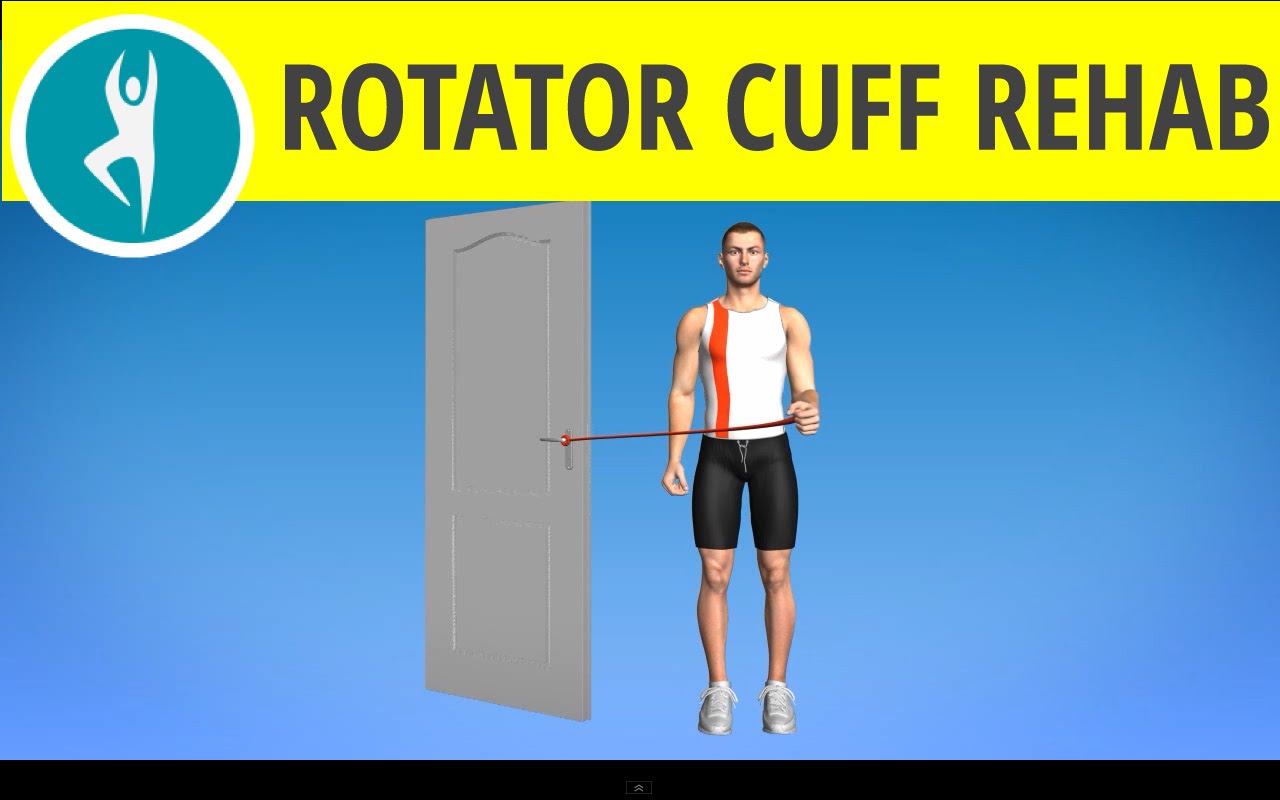
2. Rotator cuff stretch. This one requires a resistance band or tube. As we get older, we notice our shoulders deteriorating faster and getting injuries easier. Use this exercise to make sure you don’t hurt your rotator cuff. Tie the resistance band around a pole or bed post. Stand a few feet away and grab the other end. Rotate your elbow like a door hinge towards you and slowly back out. Control is the key here. Nice and slow, really use those muscles. Switch on other side. 12 repetitions for 3 sets.

rotatorcuffImage Source

3. Single-leg balance. It’s as simple as it sounds. Make sure you have something nearby to hold onto and lift up one leg, so that you’re standing just on one. Hold it for 20 seconds. Switch. Do 2 sets.

4. Laying twists. This is a great stretch for flexibility and stretching out your muscles–especially in your back. Start by laying down and spreading your arms into a T. Now drape your right leg over your left and look towards the right. You want to make sure your hips are twisting. If both shoulder blades are not on the ground, you’re moving your leg a little too far for your body. Hold for 10 seconds. Repeat on other side. Do 2 sets.

5. Opposite lifts. This is a core-strengthener. Lay down flat on a mat, arms by your side. Lift up the right arm and left leg at the same time. Now, you only want to lift the leg about 6 inches maximum from the ground. This is the point where your tummy really has to work to keep it up. Contract your abdominals. Lower both extremities, and perform on the other side. 12 repetitions for 3 sets. 

6. Cat/cow rotation. This is taken from yoga. Go onto all fours. When you inhale, lift your head up and invert your spine. When you exhale, move your head down and arch your back. Do about 10 rotations, 2 sets. 

Again, these are good for ANYONE. But especially if you’re over 60, put this into your routine. Either when you get up in the morning, during a commercial on TV, or before bed–make time for it. After all, it is your health. If you’re having trouble coming up with a routine and sticking to it, a personal trainer will probably be able to help. And we can always answer questions here.

Cheers! And as always…stay hungry and fit!

spacer

Listen to Your Body

Listen to your body. It is a simple rule that many many many of us tend to forget, including myself. Well, perhaps forget is a rather passive word, but instead ignore. And what do we do? Keep pushing our bodies even though it’s saying, “Um, hi! I’m done now, please stop!” Many of us will call this “wimping out” or just a complaint that can be pushed through. But that is where you need to acquire a skill.

This skill is understanding and knowing your own body. Picking up on the language that your body uses to communicate with your mind. Often, beginners to fitness are a little out of tune with this language. It’s taken one of my clients several months to come to the point where he can really tune into his body and understand when it is telling him to stop or push just that one rep farther.

Working it right

Working it right

Take the time in your next workout to feel out what’s going on with your body. Try to learn the difference between muscle pain (good) and joint or tendon pain (bad). If your muscles are filling with lactic acid, you can feel that pressure, that burning pain, but you know you can just do one more rep to push your body to the proper place. And if you feel your elbow joint or rotator cuff hurting with a sharp pain as you continue to bench press or curl, you know to stop before pushing yourself to injury. You have to walk that tight rope of pain. You have to know which is which.

If you’re unsure, ask a trainer. Point out what’s bothering you and they can tell you if that’s A-OK (ripping muscle fibers to make them stronger!) or a big NO-NO (overly-stressing a joint or ligament). If they’re a good, quality trainer, they will want to help you. Don’t be afraid of asking. It could save you an injury or make a workout that much better.

Chris taking a rest day with the kittens

Chris taking a rest day with the kittens

Don’t be (too) stubborn. Now here, I really need to take my own advice. Tonight we did a chest and triceps workout (here’s a sample). My (we think) rotator cuff has been a bit strained and stressed lately and can get pretty painful with certain exercises like push-ups, chest press, shoulder exercises, and other triceps exercises on the bench. I endured it pretty well tonight, but it kept me from completing as full sets as I would like. However, even though I wanted to push myself harder, I knew that it was worn out after a good number of supersets. I wanted to do another superset or so, but I held back. I didn’t want to seriously injure anything. Often, I can be way too stubborn for my own good, but here is a prime example of listening to your body.

Working myself to a good place where my skin needs to get tougher!

Working myself to a good place where my skin needs to get tougher!

So next time you’re in the weight room or out on a run, keep a finely-tuned “ear” to your body and listen to it!

Cheers! And let us know if you have any questions!

spacer

Starting a Balance Program: It’s Never Too Early!

Working at a YMCA, I work with an older population a lot of the time. This means lots of balance work. Using different exercises, different times, tempos, and so forth in order to prevent adaptation or plateauing. But the thing is, they seek me out because at their age, they have awful balance. However, if you start balance training earlier than later, you will be a happy camper. Proper balance training prevents falls and increases muscles endurance and strength in hips, buttocks, core, and small muscles of the feet. It’s time you started a balance routine today.

It doesn’t have to be a huge long thing. It could even be one balance exercise before your workout to start out. However, if you have the time, I would suggest doing a 20-minute balance routine 2-3x a week. At least!

Benefits of doing a Balance Training Program:

  • Better strength in smaller muscles
  • Stronger core
  • Reduced chance of falling and injury
  • Helps improve the connection between brain and muscles
  • Burns calories as your body struggles to stabilize

Yes, even my younger clients have complained of tiny muscles in the feet, or their hamstrings, or their hips being sore the next day due to efficient balance training. So now it’s time to start your own. Like I said earlier, at least do one balance exercise before your workouts, better to do more, if possible. Here is a list of great balance exercises to add to your routine:

  • Single-Leg Balance. This one is simple. Stand on one foot, posture straight, shoulders back. If you have poor balance or feel unsteady, have a wall nearby to hold onto when needed. 30 seconds each leg.
  • Single-Leg Balance, Eyes Closed. Same as above, but with the eyes closed. Closing the eyes throws the body off, makes it unsure of where it is. Thus, you get more wobbly. Working on this will improve your proprioception (aka, your body’s awareness of where you are even with eyes closed). 30 seconds each leg.
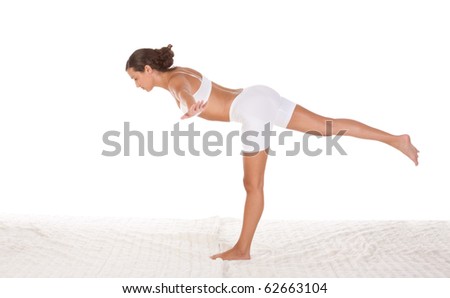
  • Airplane. Stand on one leg and lean your body forward, spreading your arms like wings of a plane. The goal is to get your body (torso) completely parallel to the ground, including the leg that is off the ground. This one is a killer for the glutes and hamstrings. 30 seconds each leg.

  • Heel to Toe [Drunk Walk]. Yes, it’s what you think it is. Imagine you get pulled over and a cop makes you walk in a straight line. I want your heel to touch your toe every time. Back and forth twice.

  • Windmill. Similar to the single-leg balance, but instead of keeping your arms still you are going to cycle them like a windmill. 30 seconds each leg.

  • Supine Leg Raise. For this one you need a foam roller. Place it along your spine, and far up enough that you can rest your head on it. You can touch your hands on the ground, but the goal is to do it with no hands. Slowly raise a leg up and lower it. Then alternate. 12 reps on either leg.

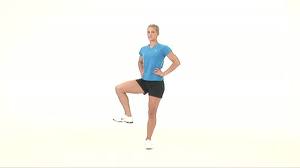
  • Single-Leg Rotation. Stand on one leg, raise the other so that your thigh is parallel to the ground. You can hold your arms out or put them on your hips. For me, it helps to hold them out. Now, slowly turn either to your left or right (depending what foot you’re on). Then come back. This is all on one leg. And you need to do it slowly. Control the muscles. 12 reps on both legs. 

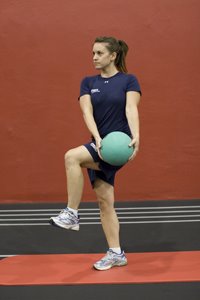
  • Single-Leg Lift & Chop. Same position as the previous one. But this time I want you to lift your arms up and chop across the body, far down. Look at the picture, but without the medicine ball. It is important to not use your momentum. Use your muscles. Control. 12 reps on both legs. 

  • Seated to Standing. This one is simple. Without pushing your hands on your knees to get up, stand from a seated position. 12 reps. 

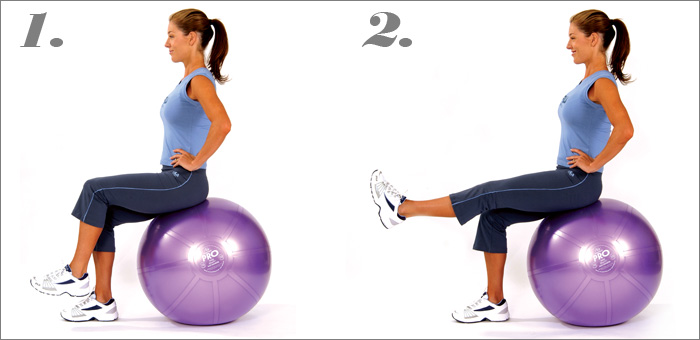
  • Stability Ball Leg Raise. Most gyms should have them. If you don’t have one, and don’t go to a gym, get one–it’s worth it. There are lots of exercises you can do with it. For this one, preferably with your hands up (you can hold your hips if you need extra stability), slowly raise your leg to full extension. Then slowly lower. Alternate. 12 reps on either side. 

  • Bosu Ball Stand. This one is simple, but there are many variations. Simply find a bosu ball, and stand upright. You may feel wobbly but attempt to stabilize yourself. If this is too easy, close your eyes. If this is still too easy, march your feet. 30 seconds. 

Remember, folks, you don’t have to do all of these. I’m giving you a big list so you can pick and choose, try new ones different days. And if you have poor balance or need more stability, do these with a wall, a rail, or a chair to hold on to. Safety first. Always. You are never to old to start balance training. There are so many benefits. It’s not a waste of time and it will save you big time in the future. Try it out.
Cheers!

spacer

Love Yourself: 30-Minute Total Body Blast [NO EQUIPMENT NECESSARY]

Hey, lovers and self-lovers out there! Today may be a day to splurge on chocolate, pastas, and fine wines (we are personally ordering pizza and kicking back since I work late), but it is also a day to show your body some love! You can’t be unfair and only treat your taste buds, treat your body too. Find 30 minutes out of your busy day to kick your own butt! In a kind and loving happy way. This is a home workout, you don’t need any weights–just keep moving! So no excuses! Keep a water bottle nearby.

30-Minute Circuit Total Body Blast

We are going to be doing a circuit of 10 stations for 1 minute each. Think you’re ready? Let’s do it!

1. Jump rope. Whether you have an actual jump rope or not, do this at a fast pace.

English: into the groove double dutch jump rope

English: into the groove double dutch jump rope (Photo credit: Wikipedia)

2. Plie squats. More information on these if you click the link, these should be done slowly.

Here's me with weights, but they are unnecessary for all

Here’s me with weights, but they are unnecessary for all

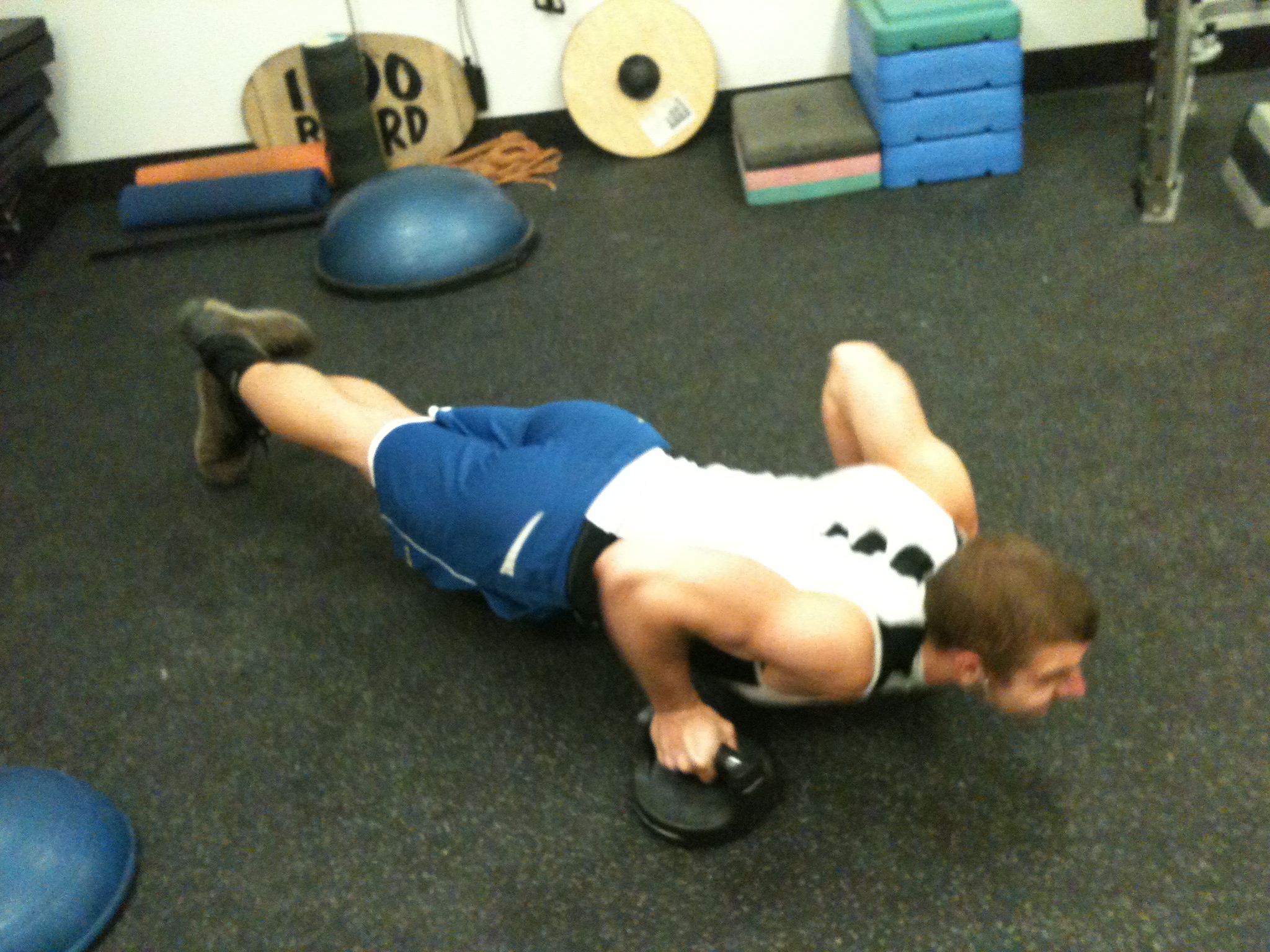
3. Push-ups. More information at the link, you can do them regular or knee-style, whatever your strength level is at.

Push-ups

4. Mountain climbers. These are quick. The faster you go, the more you burn!

5. Plank. Click the link for more information. Make sure you’re doing this right or I’ll sit on you.

6. Supermans. For these, you are on your belly and you lift your arms and your legs, with your torso still on the ground. You go up for about a second and then down, and then up and down, etc.

7. High knees. Hold your hands/arms parallel to the floor at a high level and kick your knees up to try to get them to your hands. These are FAST.

8. Lunges. Hands on the hips in starting position, lunge out forward with one leg, then back, lunge out with the other leg and back. Make sure that back leg is getting low to the ground.

9. Dips. Using a bench, a chair, a couch, anything really, hold onto the object, facing away from it and dip down, using your triceps.

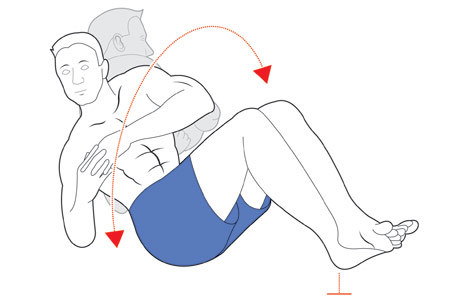
10. Russian twists. Sit up with your legs off the ground and twist your shoulders back and forth (your whole torso), hitting either side with your hands. Make sure you are doing a full twist.

X3. To do this full workout, you must do this circuit three times. And 1 minute at each station (use an iPhone, a timer, stopwatch, something to keep track of time). You may need rest in between, but get a sip of water and try to keep going. Keep that heart rate up and the sweat flowing. And if you only have 20 minutes, then you can just make it two circuits instead of one. I know you have 20 minutes to spare today before you spend it with your love or your friends or your pets. If you’d rather have a shorter, more repetitive 15-min workout, click here. And click here for more circuit training ideas.

Let us know if you have any questions, and as always, stay hungry and fit! Cheers!

spacer

Beginner’s Guide to Supplements

This post is essentially a direct email to a close friend of mine that I brought more into the world of fitness last year before I moved. One of my former pupils is now helping him but there are always questions that need to be answered. This response to one of his questions is going to be used as the topic of this post as a result of his request. It is, therefore, to a certain degree catered to his personal needs. I could have just told him to go to Amazon or Bodybuilding.com to read product reviews, but that wouldn’t be very nice, would it?

Disclaimer: The following is to a certain degree my opinion and personally professional way of explaining some very complicated matters. Although I have knowledge based on formal education and years of experience and experimentation, the language used may not necessarily be technically or scientifically accurate. It is merely a useful means to explain complex processes and ideas in a way that everyone can understand, visualize, and implement. If you have an issue with the way I do what I do, please send us an email. Thank you =)


Note: This will not be very in-depth. For more specific questions, please message us. We will answer ALL questions.


I am going to break this into a few sections. First, I will be dealing with general vitamins, minerals and similar products that relate to nutrition and dieting. Then I will go into three sections that highlight pre, intra (or during), and post workout related supplements. If you are looking for anything about proteins, skip to the post workout section.


Vitamins and minerals are an important part of the operation of our body’s various systems. Common vitamins such as A, B, C, D, and E are very beneficial for our health. While we can obtain them from certain foods and even our environment, sometimes a multivitamin will provide us with a consistent intake. Also, anti-inflammatory and pro-health supplements that are found in nature, such as turmeric and curcumin are low risk options. For more information about those, check out Monica’s Health Mag.


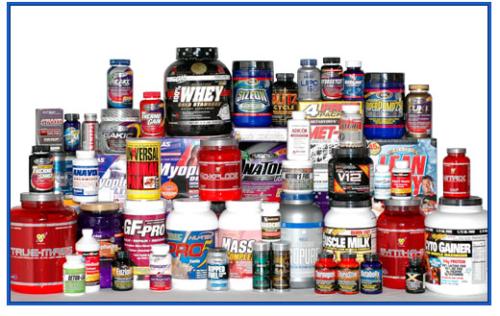
I recommend a few “multivitamins.” First, Kirkland has one of the only USP verified products on the market and it is very affordable. Emergen-C is a different means of consumption (a powder that is mixed in liquid) but you need to be aware that it is believed that it can be harmful to the enamel on your teeth. For those that are training hard, Universal Animal Pak is a more serious product that contains 11 pills in one “half-serving.”. I would recommend those products over other brands for performance and value.
 
Creatine: This is an organic acid that is present in vertebrates. That means that is a natural compound that is already inside of you! It’s purpose is to provide energy to various parts of your body, mainly your muscles. For anyone questioning taking creatine, please recognize that it is not a high risk product if taken properly and it can have positive results on your growth and development when paired with an effective physical fitness routine. I would recommend taking Optimum Nutrition’s Micronized Creatine Powder. It is a simple monohydrate, more natural and basic essentially. Try to take it in six week on and off cycles, performing a loading stage the first week and a maintenance stage for the next five. In the loading stage, take one scoop (teaspoon) with every macro or major meal, and one heaping scoop post workout. (Realize that many pre/intra/and post workout supplements also contain creatine.) During maintenance, take a scoop post workout.


Pre-Workouts: Many of these products contain various vitamin b, amino acids, and what I will refer to as aerating compounds. They essentially get more air to your blood and provide you with a placebo effect pump up feeling. I am not the largest supporter of these products and the massive amount of them that exist. They conveniently affect everyone differently. Even if it only makes you think that it is working, that might help your workout. They can potentially reduce lactic acid buildup, allowing you to perform more repetitions and further tear your muscle fibers before fatigue sets in too far. I recommend Cellucor C4 if you want one that tastes better. MusclePharm Assault is another one that tastes alright and is more effective. If you want a better value, try Jack3d. Try to stay away from lemonades and fruit punches, they usually taste worse. Usually stick to one scoop, but follow directions. I like to take these on an empty stomach, but I have a sensitive stomach so it’s up to you.


Intra-Workouts: Again, I am even less of a fan of these products. They are very similar to pre-workouts, but they provide you with more carbohydrates and electrolytes to help you maintain endurance based strengths throughout a workout. These are more useful for longer workouts. I recommend Cytosport’s Cytomax. Ask for flavor recommendations, but they are all relatively good in terms of taste. Take one scoop for an hour-long workout, or two for a two-hour long workout. Make sure you double your amount of water if doubling scoops.


Post-Workouts: Protein supplements are the reason this article was written. I recommend that you eat a gram of protein for every pound you want in your goal weight. I want to weigh 225 pounds again, so I shoot for at least 225 grams of protein a day. Sometimes that can be hard to achieve on a certain budget or with time restraints. Protein powders provide a reasonably priced and very dense protein serving, and they usually have other vitamins, minerals, and amino acids as well. Thus, you can quickly hit a protein goal by making a shake with these powders. I prefer eating real foods for protein, fish being my go to.


Nevertheless, if you are looking for a more complex and tasty product, I recommend Cytosport’s Muscle and Monster Milks. BSN’s Syntha-6 is a good value, mixes well, and tastes alright. For the purists out there, I would stick to Optimum Nutrition’s Isolated Whey Protein and Isolated Casein Protein. Now, it is up to you, but do not try the crazy flavors like Cookies n’ Cream. They are awful. Stick with chocolate or vanilla, depending on your preference. Moving backwards, whey protein is derived from the process of making cheese while casein is more so derived from the milk of mammals directly. Whey breaks down and is processed faster, so I usually take it during the day. Casein processes slower but is still protein packed so I usually take it before going to sleep. Get both if you’re super serious, or whey if you’re starting out easy.


A post for dieting and nutrition will be made in the future and it will go more into depth of how these products can fit into your diets. For now, here are just introductory tips and product recommendations.


Cheers!
spacer